Decoding Functions: Which Equation Represents the Transformed Function Below?
The question "which equation represents the transformed function below" is a cornerstone of mathematical analysis, bridging abstract theory with tangible applications. Whether you're solving for a shifted parabola, a reflected exponential curve, or a scaled trigonometric wave, the ability to identify the correct equation hinges on mastering transformation rules. These rules—shifts, stretches, reflections, and compressions—are not mere academic exercises but the language through which functions communicate their behavior. Misidentify a transformation, and the entire model collapses; recognize it correctly, and you unlock insights into patterns from physics to economics.
Yet, despite its ubiquity, this skill remains elusive for many. Textbooks often present transformations as isolated procedures, but in practice, they compound. A function might undergo a horizontal shift and a vertical stretch and a reflection—all before you’ve even plotted its original form. The challenge lies in dissecting the final equation to reverse-engineer each step, a process that demands both algebraic rigor and spatial intuition. The stakes are higher in fields like engineering or data science, where a misaligned transformation could skew simulations or misinterpret trends.
The key to solving "which equation represents the transformed function below" lies in systematic decomposition. Start with the parent function—its shape, intercepts, and asymptotes—then apply transformations in a logical order. A reflection over the y-axis? That’s f(x) → f(-x). A vertical stretch by a factor of 3? Multiply the output by 3: 3f(x). But what if the transformation is nested, or the function is composite? Here, the rules become recursive, and the equation’s structure must be parsed like a sentence—each operation a clause contributing to the final meaning.
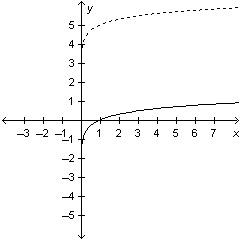
The Complete Overview of Function Transformations
Function transformations are the algebraic and geometric operations that alter a function’s graph without changing its fundamental nature. The question "which equation represents the transformed function below" forces practitioners to engage with these operations dynamically, moving beyond rote memorization to active interpretation. At its core, a transformation is a mapping: it takes an input x and outputs a modified value based on predefined rules. For example, the function f(x) = x² becomes f(x-2) + 3 when shifted right by 2 units and up by 3, but the equation itself must reflect this precisely to avoid misrepresentation.The complexity arises when transformations interact. A horizontal shift f(x-h) combined with a vertical reflection -f(x) creates a new graph that’s both translated and flipped. The equation must encapsulate both operations in the correct order—substitution first, then negation—to yield the accurate transformed function. This interplay is why "which equation represents the transformed function below" is rarely a straightforward substitution problem; it’s a puzzle where the order of operations dictates the solution.
Historical Background and Evolution
The study of function transformations traces back to the 17th century, when René Descartes formalized the Cartesian plane, linking algebra to geometry. His work laid the groundwork for understanding how equations could be visualized as curves, but it wasn’t until the 19th century that mathematicians like Leonhard Euler and Joseph-Louis Lagrange systematized transformations as tools for solving differential equations. Euler’s notation f(x) itself became a shorthand for describing how inputs map to outputs, while Lagrange’s work on series expansions revealed how transformations could simplify complex problems into manageable forms.The modern framework for transformations emerged in the 20th century, particularly through the works of mathematicians exploring group theory and symmetry. Transformations—whether linear, affine, or nonlinear—became a unifying concept across disciplines. In applied mathematics, engineers used transformation rules to model real-world phenomena, from the harmonic oscillations of springs to the nonlinear dynamics of fluid flow. Today, the question "which equation represents the transformed function below" is as relevant in machine learning (where kernel functions transform input spaces) as it is in classical calculus.
Core Mechanisms: How It Works
The mechanics of function transformations revolve around three primary operations: shifts, stretches/compressions, and reflections. Each operation modifies the function’s graph in a predictable way, and the corresponding equation must reflect these changes accurately.Table of Contents
- The Complete Overview of Function Transformations
- Historical Background and Evolution
- Core Mechanisms: How It Works
- Key Benefits and Crucial Impact
- Major Advantages
- Comparative Analysis
- Future Trends and Innovations
- Conclusion
- Comprehensive FAQs
- Q: How do I determine which equation represents the transformed function below if multiple transformations are applied?
- Q: Can a function be transformed in a way that changes its domain or range?
- Q: What’s the difference between a horizontal stretch and a vertical stretch?
- Q: How do I verify if my transformed equation matches the graph?
- Q: Are there transformations that cannot be represented algebraically?
1. Shifts: Horizontal shifts are represented by f(x-h) (right shift by h units) or f(x+h) (left shift). Vertical shifts use f(x) + k (up) or f(x) - k (down). For example, if the original function is f(x) = √x, shifting it right by 4 units yields f(x-4) = √(x-4).
2. Stretches/Compressions: Vertical stretches by a are a·f(x), while horizontal compressions by b are f(bx). A vertical stretch by 2 of f(x) = sin(x) becomes 2sin(x), but a horizontal compression by 0.5 becomes sin(2x) (note the reciprocal relationship).
3. Reflections: Reflecting over the y-axis is f(-x), and over the x-axis is -f(x). Combining these—say, reflecting f(x) = eˣ over the y-axis and then down by 1—gives -e⁻ˣ + 1.
The critical insight is that transformations are applied in a specific order: horizontal transformations (inside the function’s argument) precede vertical transformations (outside). This hierarchy ensures the equation accurately mirrors the graph’s alterations. For instance, the transformation f(2x) + 3 first compresses the graph horizontally by a factor of 2, then shifts it up by 3 units.
Key Benefits and Crucial Impact
Understanding how to identify "which equation represents the transformed function below" is more than an academic exercise—it’s a practical skill with far-reaching implications. In physics, transformations simplify the analysis of periodic motion, allowing engineers to predict the behavior of pendulums or sound waves by adjusting parameters in a single equation. In economics, transformed functions model supply and demand curves under varying conditions, such as shifts due to inflation or technological advancements. Even in computer graphics, transformations are the backbone of rendering 3D models, where rotations and scaling are applied via matrix operations derived from function transformation principles.The ability to reverse-engineer transformations also fosters deeper mathematical intuition. When faced with a complex equation, breaking it down into its constituent transformations reveals hidden symmetries and relationships. For example, recognizing that f(x) = (x-1)² + 2 is a parabola shifted right by 1 and up by 2 units allows one to sketch its graph instantly, a skill invaluable in fields like architecture or robotics where spatial reasoning is critical.
"Mathematics is the music of reason," —James Joseph Sylvester. Yet, the harmony of that music is often found in the transformations that bridge abstract symbols to tangible results. The equation that answers "which equation represents the transformed function below" is not just a solution; it’s a translation of how the world’s patterns can be reshaped, analyzed, and predicted.
Major Advantages
- Precision in Modeling: Transformations allow functions to be adapted to specific scenarios without altering their fundamental properties. For instance, a logistic growth model can be shifted to match real-world data by adjusting parameters, ensuring accurate predictions.
- Simplification of Complex Systems: By decomposing a transformed function into its base components, practitioners can isolate variables and analyze their individual impacts, a technique used in control theory and signal processing.
- Enhanced Problem-Solving: Recognizing transformations enables quicker identification of solutions. For example, solving sin(x) = 0.5 is straightforward once the periodic nature and phase shifts of the sine function are understood.
- Cross-Disciplinary Applications: From biology (modeling population dynamics) to finance (adjusting discount rates), transformations provide a universal language for describing change.
- Error Reduction: Misidentifying a transformation can lead to incorrect conclusions. For example, confusing a horizontal stretch (f(x/2)) with a vertical stretch (2f(x)) would yield entirely different graphical interpretations.

Comparative Analysis
| Transformation Type | Equation Representation |
|---|---|
| Horizontal Shift (Right by h) | f(x - h) |
| Vertical Stretch (Factor a) | a·f(x) |
| Reflection Over y-Axis | f(-x) |
| Combined: Shift Right by 3, Reflect Over x-Axis, Stretch Vertically by 4 | -4f(x - 3) |
Future Trends and Innovations
As mathematics continues to intersect with technology, the question "which equation represents the transformed function below" will evolve alongside computational tools. Symbolic mathematics software, like Mathematica or SymPy, now automates transformation analysis, but the underlying principles remain essential for validating results. In machine learning, kernel functions—essentially transformed feature spaces—are redefining how algorithms process data, making transformation theory more relevant than ever.Emerging fields like topological data analysis also rely on transformations to study the shape of complex datasets. Here, functions are transformed to reveal underlying structures, such as holes or connected components, which traditional methods might miss. The future of transformations lies in their ability to adapt to high-dimensional spaces, where visual intuition is limited, and algebraic precision becomes paramount.

Conclusion
The pursuit of answering "which equation represents the transformed function below" is a journey through the intersection of algebra and geometry, theory and application. It demands not just memorization but an active engagement with the language of functions—how they bend, stretch, and reflect to mirror the world’s complexities. From the foundational work of Descartes to the modern applications in AI, transformations remain a constant thread, weaving together disparate fields under a single mathematical framework.Mastery of this skill is not about solving equations in isolation; it’s about recognizing the hidden structure in data, the symmetry in nature, and the patterns that govern everything from the flight of a projectile to the growth of an economy. The next time you encounter a transformed function, remember: the equation isn’t just a solution—it’s a window into how the world’s mechanisms can be understood, manipulated, and predicted.
Comprehensive FAQs
Q: How do I determine which equation represents the transformed function below if multiple transformations are applied?
A: Apply transformations in this order: horizontal shifts/compressions first (inside the function’s argument), then reflections, and finally vertical stretches/shifts (outside the function). For example, for f(x) transformed to 2f(-x + 4) - 1, the steps are: reflect over y-axis (f(-x)), shift right by 4 (f(-(x-4))), stretch vertically by 2 (2f(-(x-4))), then shift down by 1 (2f(-(x-4)) - 1).
Q: Can a function be transformed in a way that changes its domain or range?
A: Yes. Horizontal shifts (f(x-h)) preserve the domain but may affect the range if the function is unbounded (e.g., 1/x shifted right remains undefined at x = h). Vertical stretches (a·f(x)) preserve the domain but scale the range (e.g., 2sin(x) has range [-2, 2]). Reflections (-f(x)) invert the range but keep the domain.
Q: What’s the difference between a horizontal stretch and a vertical stretch?
A: A horizontal stretch by b is represented by f(x/b) (e.g., f(x/2) stretches the graph horizontally by a factor of 2), while a vertical stretch by a is a·f(x) (e.g., 3f(x) stretches the graph vertically by 3). The key difference is where the transformation is applied: inside the argument for horizontal, outside for vertical.
Q: How do I verify if my transformed equation matches the graph?
A: Plot key points from the original function and apply the transformations to them. For example, if f(x) = √x has a point at (4, 2), transforming it to f(x-1) + 3 moves the point to (5, 5). Check if this new point lies on the graph of the transformed equation. Additionally, analyze asymptotes, intercepts, and symmetry to confirm consistency.
Q: Are there transformations that cannot be represented algebraically?
A: Some transformations, like non-linear warping or fractal scaling, require advanced mathematical tools (e.g., conformal mappings or iterative functions) to describe. However, for standard polynomial, exponential, or trigonometric functions, all transformations can be expressed algebraically using the rules outlined above.
Leave a Comment
Comments are moderated before appearing. The data you submit is processed according to the Privacy Policy of naset.com.